The "Rubber Sheet" Fallacy & Intuitive Misconceptions
In popular science documentaries, you have almost certainly seen this classic visual metaphor: a heavy lead ball is placed on a stretched sheet of rubber, creating a funnel-like dip. Other smaller marbles are rolled across the sheet, orbiting or sliding towards the center under "gravity."
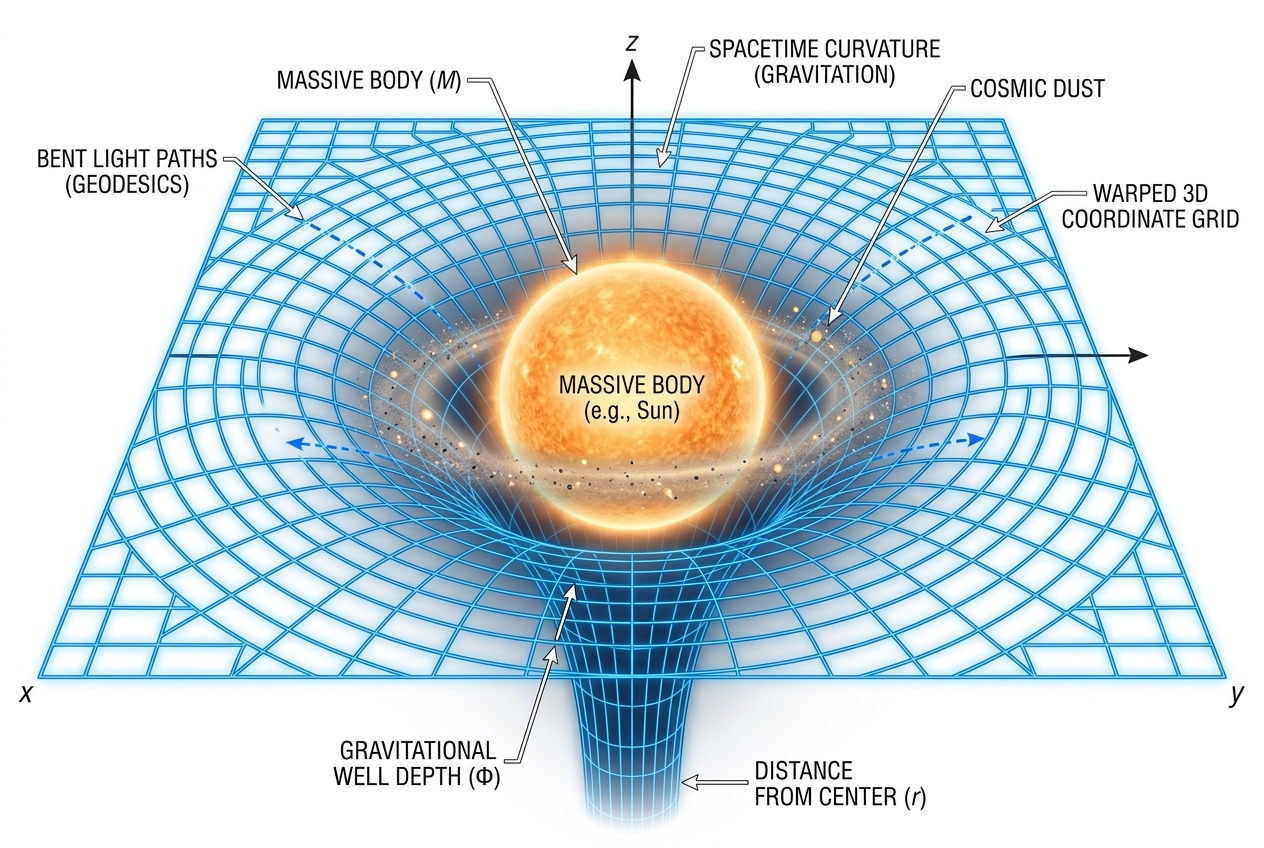
Physicist John Wheeler famously summarized this interaction: "Matter tells spacetime how to curve, and curved spacetime tells matter how to move." However, as a teaching tool, the rubber sheet analogy hides three fatal conceptual flaws.
Trap 1 Circular Logic: Explaining Gravity with Gravity
The marble rolls toward the central heavy ball only because Earth's downward gravitational pull pulls the lead ball down, deforming the sheet into a physical slide. Without an external, pre-existing gravity, the sheet would not curve, and the marble would not roll. It assumes gravity to explain gravity.
Trap 2 The Missing Dimension: Omitted Time
General Relativity describes 4-dimensional spacetime (3 space + 1 time dimensions). In fact, for slow-moving objects in daily life (like a falling apple or a planet orbiting), the bending of time (gravitational time dilation) is responsible for over 99% of what we perceive as gravity. The rubber sheet completely ignores the temporal warp.
Trap 3 Intrinsic vs. Extrinsic Curvature
The rubber sheet dips "downwards" into a third physical dimension. This misleads people into thinking that our 3D space must bend into a physical "fourth spatial dimension". In reality, spacetime curvature is intrinsic. It is defined entirely within our own dimensions by how clocks tick and rulers measure at different points, without needing any higher dimensional space.
Truth Gravity Is Not a Force
In General Relativity, gravity is purely geometric. Objects do not experience a pulling force; they simply move in a straight line under inertia. In warped spacetime, this straightest possible path is called a Geodesic. To a distant observer, this geodesic trajectory looks curved, appearing as a gravitational orbit.
How Mathematics Unifies Dimensions: Metrics & Tensors
Without relying on the visual "dipping" analogy, how do we mathematically define this "intrinsic curvature" across arbitrary spatial dimensions? The answer lies in two concepts: Metrics and Tensors.
A metric is a mathematical object that defines how to calculate the distance ($ds$) between two neighboring points in a given coordinate system.
In a flat 2D Euclidean plane, the distance between points conforms to the Pythagorean theorem:
As we move from 2D space to 3D space and 4D spacetime, the fundamental laws of physics must not depend on the coordinate systems we choose to overlay on the universe.
A Tensor is a geometric entity whose components transform under coordinate changes in a highly specific covariance/contravariance rule, ensuring the underlying physical relationships remain identical.
This absolute rule is known as General Covariance. The core equation of gravity, the Einstein Field Equations:
Anatomy of Curved Spacetime: The Schwarzschild Metric
When we place a spherically symmetric mass $M$ in vacuum, it distorts the surrounding metric. In 1915, Karl Schwarzschild solved Einstein's equations to find the exact metric for this setup, creating the Schwarzschild Metric.
INTERACTIVE EXPLORATION: HOVER OVER EACH TERM TO UNCOVER ITS PHYSICAL MEANING
Deriving Flamm's Paraboloid: The Real Spatial Embedding
If spacetime isn't a rubber sheet, what does its actual spatial slice look like? To visualize the spatial geometry, we can take a snapshot of space at a constant moment in time ($dt = 0$), along the equatorial plane ($\theta = \pi/2$).
The metric on this 2D spatial slice reduces to: \(ds^2 = \frac{1}{1 - r_s/r} dr^2 + r^2 d\phi^2\). This is clearly a curved space.
To visualize this curved surface, we can mathematically "embed" it inside a flat 3D space described by cylindrical coordinates $(r, \phi, z)$.
In flat 3D cylindrical coordinates, the spatial distance is: $$ds^2 = dr^2 + r^2 d\phi^2 + dz^2 = \left[ 1 + \left(\frac{dz}{dr}\right)^2 \right] dr^2 + r^2 d\phi^2$$ To make this flat 3D slice match the geometry of our Schwarzschild spatial slice, we equate the $dr^2$ coefficients: $$1 + \left(\frac{dz}{dr}\right)^2 = \frac{1}{1 - \frac{r_s}{r}}$$ Solving for the slope $dz/dr$ gives: $$\left(\frac{dz}{dr}\right)^2 = \frac{r_s}{r - r_s} \implies \frac{dz}{dr} = \pm \sqrt{\frac{r_s}{r - r_s}}$$ Integrating this equation yields the height $z$ as a function of radius $r$:
While it looks like a funnel, Flamm's paraboloid is mathematically rigorous and physically different from the rubber sheet analogy:
- No External Gravity Needed: The curvature is defined by metric coefficients, not by an external downward pulling force.
- The Event Horizon: At $r = r_s$ (the Schwarzschild radius), the slope $\frac{dz}{dr}$ becomes infinite (vertical), showing the boundary of the horizon.
- Einstein-Rosen Bridge: The $\pm$ roots represent two symmetrical sheets that connect at the throat $r = r_s$, forming a mathematical bridge (wormhole) between two asymptotically flat universes.
Spacetime Curvature Sandbox
This sandbox renders a real-time, interactive 3D representation of Flamm's Paraboloid based on the equations of General Relativity. You can click and drag on the viewport to rotate the angle, and use the controls to modify the parameters of the central gravitating mass.
Epilogue: Intrinsic Curvature & The Reality of Spacetime
While Flamm's paraboloid successfully visualizes spatial bending using mathematics, we must remember: it is a mathematical aid, not a literal description of our universe.
There is no higher-dimensional $z$-axis for our space to sink into, nor does space "hollow out." This curvature is intrinsic, defined inside our universe by how distances and time steps are measured.
Imagine two travelers who start at the Earth's equator and walk in straight lines due north. Even though they are walking parallel to each other, they will eventually collide at the North Pole. They do not collide because a force pulled them together, but because the surface they are walking on is curved.
So too it is with gravity. Massive objects modify the metric tensor $g_{\mu\nu}$ of the spacetime grid. By warping time and stretching space, they change what it means to go straight. What we feel as gravity is not a pull, but the simple motion of going straight through a warped and ticking world.